Friday, 15 May 2015

Media Ownership

Ill Manors:

  • Film London Microwave is Independent
  • BBC Films is owned by BBC
  • Aimimage is Independent
  • Gunslinger (co-production)
  • Head Gear Films
  • Ill Manors
  • Metrol Technology 
Trains crew so they're approvable and successful.

Skyfall: 
  • EON Productions is owned by Danjaq
  • Distributed by Columbia, which is owned by Sony Pictures
Sony Products
  • Motion pictures
  • Television Production
  • Television Syndication
  • Online games
  • Mobile Entertainment
  • Video on demand
  • Digital distribution
Sony Pictures is owned by Sony 

Frozen:
  • Walt Disney Pictures is owned by the Walt Disney Studios
  • Walt Disney Animation Studios is owned by the Walt Disney Studios


Wednesday, 13 May 2015

"Synergy Is A Vital Process in the Successful Marketing of Media Products to Audiences", to What Extent Do You Agree With This Statement?

Plan:

Introduction:

Describe what a synergy is and give an insight as to whether I agree with the statement or not. Synergy is used by conglomerate film companies to create products of a greater sum than their potential individual efforts to market the film.

Paragraph One: 

Write about the various types of synergy, such as books, video games, theme parks, sequels, etc. Reference Frozen.

Frozen Synergy:

  • Video Games for DS and 3DS.
  • Various forms of Frozen merchandise on Amazon, e.g. plush toys, costumes, books.
  • Frozen sequel in the making.
  • Soundtrack.
  • Frozen-based rides in Disney World.
  • Behind The Scenes TV show.

Paragraph Two: 

Write about synergy in terms of independent film companies, and how they market their films otherwise. Reference Ill Manors.

Ill Manors Synergy:

  • Ill Manors Soundtrack 
(The lack of synergy meant a lack in marketing the film)

Paragraph Three:

Compare Frozen and Ill Manors in terms of synergy and write about whether the statement is agreeable to both companies or not. (For Frozen, synergy was a vital process in its marketing stage, whereas Ill Manors did not market their films with a variety of products, so it was probably not a vital process in their stage of marketing.


Conclude:
Giving an explanation as to whether synergy is a vital process for big conglomerate companies, and if it is a vital process for independent film companies.


Dylan Mann-Hazell

Tuesday, 12 May 2015

Representation of Age


The first way in which age is represented in this clip is through mise-en-scene, specifically in the area of body language. The younger boy is forced to look up at the older male due to his position in the courtroom. This portrays the older male as more powerful and more in control, and is immediately noticeable as the clip opens with its over-the-shoulder shot. Body language is also used to portray the younger male as vulnerable, as if he is being scolded, denoting the character with his shoulders hunched and his head bowed down, occasionally looking up. Another example of mise-en-scene that helps construct the representation of age is the costumes. All of the people working in the courtroom are wearing grey wigs. Although this is a typical appearance of a judge, it can be pointed out that a stereotype of elder people is that they have grey hair. This perhaps allowed the audience to see that there is a distinct difference in age between the judge and the young boy. Mise en scene again features in this clip in terms of the setting. The younger boy is separated from everybody else by a box, making him seem vulnerable and alone, thus representing young people as weaker than older people.

Sound is also used to portray age is specific ways. The use of diegetic sound in terms of dialogue is common within this extract. The younger male is clearly portrayed as struggling to form a sentence quickly, and stuttering occasionally. This conflicts with how the older male is portrayed, for he seems to be very well spoken and completely at ease in terms of how he speaks. Also, he is replying to the boy so quickly that he is almost interrupting him, perhaps indicating that older people can be somewhat disrespectful to the younger people without punishment. As the clip progresses, non diegetic music can be heard, sounding quite ominous and dangerous as the younger boy speaks. This represents younger people as quite untrustworthy and people to be wary of. Diegetic sounds like sniffing and heavy breathing are also featured with the younger male, portraying him yet again as weak and child-like.

Camera angles are used concerning the representation of age in many ways. For example, the judge is mostly always shown at a low angle, forcing the audience to look up at him. This portrays him as powerful and as having authority. There are times in the clip also where the younger male is shown at a high angle, giving the audience a view of looking down at him. This is to achieve the opposite effect, making him look small and weak. Later on in the extract, a close up shot is used to show the boys reaction and body language, for example in the shot where boy rests his head on the desk, as if trying to hide from the judge and his questions, making his actions and overall behaviour seem quite child-like.

Editing is also used in this extract to represent the differences in characteristics and behaviour of various ages. The shots of the young male answering the questions given to him are long and drawn out, making it seem like he is struggling to come up with answers to these questions. This portrays young people as not yet capable of correctly forming sentences in a short period of time. However, the shots of the judge are fast and indicate that he is speaking at a fast, even pace, which connotes that the older male is superior in terms of his speech.

Key Words:

Denote - What can be seen
Conote - What can be conveyed
High Production Value
Low Production Value
Verisimilitude - Situation looks real
Narrative - A story constructed in detail
Linear - Chronological
Circular- Not from start to finish
Parallel Editing: Scenes happening at the same time but in different locations

Tuesday, 5 May 2015

Discuss the Issues Raised by Media Ownership in the Production, Distribution and Exchange of Media Texts in your Chosen Media Area

The term 'Media Ownership' refers to the process where an increasingly small number of companies own most media outlets. This process has an effect on production, distribution and exhibition companies in both positive and negative ways.

The first way media ownership raises issues within production companies is that producers cannot take as many risks, due to the size of the market that they have to satisfy with their product. Although this could be potentially problematic in terms of the quality of the movie, there are advantages for production companies as well in terms of media ownership. An example of such an advantage is that, with a big conglomerate, the company would not need to collaborate with other companies to ensure they get a prophet, due to how successful they already are. Also, big conglomerate production companies can be more ambitious when making the film by using celebrities, better quality (HD, 3D, IMAX) and using broader locations to shoot in.

Distribution companies do not really face any issues when it comes to media ownership, instead having the advantage of synergy. Synergy can be used to promote the film, such as through video games, soundtrack, merchandise, etc. An example of synergy is within Disney and their various products sold at supermarkets, such as plush toys, their clothing range and posters. This is an advantage for distribution companies for it is a good way to promote and market the film to exhibitors and their audiences.

Exhibition companies also face advantages and disadvantages concerning media ownership. An advantage for exhibitors is that their companies will have more audiences if their product has been marketed and advertised well. For example, the film Skyfall features famous actors such as Judi Dench and Daniel Craig, both of which featured in all the trailers, and many posters advertising the release of the film. The trailers also featured many of the special effects and action sequences that occur in the film, so it can be ensured that the institutions make a prophet. A disadvantage for exhibition companies however is that the film has to do well at the box office in order for all three of the institutions to make a prophet, making it quite risky to exhibit small independent company-made films.

To conclude, media ownership has both a positive and negative effect on the institutions, particularly production and exhibition companies. More well known companies are likely to not have to worry about competition unlike independent small companies that need to make a prophet. This therefore makes production companies face the most issues in terms of media ownership rather than distribution or exhibition.

Tuesday, 28 April 2015

Representation of Disability


The extract opens straight away with some diegetic dialogue from a woman who is stating that she 'didn't think there was anything strange about Billy'.  This immediately allows the audience to infer that 'Billy' has done something that would warrant being called strange. A cut is then made, showing a different location and a tracking shot of a man walking down a road, dusting himself off. It can be assumed by the audience that this is Billy, due to the previous dialogue. With this cut comes some non diegetic music, which could be described as suspicious or eerie, suggesting that Billy has done something wrong. His body language and the action of dusting himself off also portrays this theory. The makeup used on Billy's face and his costume are quite dirty and scratched, showing a contrast with the clean police uniform shown later.

Soon after, another tracking shot of Billy is shown, apparently oblivious to the police that were shown nearby in previous low angle shots. Those with a disability are being represented in this clip as somewhat ignorant to their surroundings, until Billy notices the police in a low angle reaction shot, and runs off frame. A high angle of the police restraining Billy is shown, forcing the audience to look down on him. This shot is used to represent disabled people as significantly weaker than people without a disability. This is further represented in the clip through the dialogue by Billy: 'I haven't done anything wrong' in a pleading tone, showing him submitting to the police.

After the opening titles, a tracking shot showing a group of people outside a house guarded by police is shown, portraying the concern of people without a disability for those with a disability. A cut is then made to the inside of the house, showing a high angle of Billy's father and Detective Frost talking quietly. Frost asks the father if Billy could be considered mentally subnormal, and after being corrected as to what is the correct form of address, he apologises. This piece of dialogue represents abled bodied people as wary or even scared to come across as mistreating disabled people. During another tracking shot Billy's mother approaches, informing Frost that Billy would feel better if she could clean him up. This part of the extract represents disabled people as needing help from abled bodied people to complete basic tasks such as cleaning themselves.

When Frost and Billy's father enter the room, yet another tracking shot is made, following Billy's father who is approaching Billy. Billy immediately looks up and tells his father that he hasn't done anything, to which his father replies in a gentle manner to calm him down. As Frost sits down, a close up shot of Billy is made, showing his reaction. His head is tilted and he looks quite curious and we notice that Billy is sat lower than the others. This gives the impression that he is vulnerable or perhaps representing him as a lower status than the other two men in the room. Frost starts talking to Billy in a condescending and patronising way implying that Billy needs to be treated like he is a child. It can be seen that Frost is becoming increasingly frustrated that Billy isn’t listening to him and is not participating with any of the questions through his body language, (repositioning himself, leaning in closer).

To conclude, mise-en-scene, sound, editing and camera work have all been used throughout this extract to portray disabled people in certain ways. The ways in which the audience react to disability in dramas generally varies, with reactions such as discomfort, indifference or sorrow, depending on how they are perceived in the show.

Friday, 24 April 2015

What is the significance of the proliferation of hardware and content for institutions and audiences?

Plan:

Paragraph One:


What is the significance of the proliferation of hardware and content for producers?
  • Advantages: Cameras are cheaper
  •  Producers can spend more money on the computers and the quality of films in terms of CGI, graphics, 3D, etc. (D-Box). Skyfall is an example of how much money needs to be used to succeed in competition.
  • Disadvantages: Due to the cheaper cameras, more competition has been created for producers to create a popular film. Ill Manors is an example of a small budget film that was not able to compete with larger film and film companies.
Paragraph Two:

What is the significance of the proliferation of hardware and content for distributors?
  • Advantages: Marketing is easier because audiences have more chance at seeing the film being marketed through social media and Web 2.0 (the internet), via their phones, tablets, iPads, laptops, iPhones, etc. Skyfall and Ill Manors both had websites, pages, trailers and posters.
  • Synergy can be used more effectively due to the proliferation of hardware. (video games, CD's)
  •  Disadvantages: Audiences have access to sites such as YouTube therefore they can create their own films, creating more competition for the film industry.
Paragraph Three:

What is the significance of the proliferation of hardware and content for exhibitors?
  • Advantages: Various ways to watch movies have been created, such as Netflix and LoveFilm, therefore making audiences more likely to watch the movie. High budget, popular movies such as Skyfall (of which had a budget $200 million) may be more likely to be on these forms of movie watching, however, films like Ill Manors (with a budget of £100,00) may not be well known enough to feature on these sites.
  • Disadvantages: The ways in which audiences can illegally watch movies have also expanded, especially since the invention of Web 2.0.
Paragraph Four:

What is the significance of the proliferation of hardware and content for audiences?
  • Advantages: Easier to gain access to high quality movies through various manners such as the internet (Netflix, LoveFilm) and DVD/Blu-Ray.
  • A subscription to a site such as Netflix tends to be worth the money due to the extensive choice of films and TV shows available.
  • Disadvantages: Piracy videos tend to be bad quality, which audiences may be tempted to watch due to the fast access and lack of money spent on it. 

Tuesday, 21 April 2015

To What Extent Does Digital Distribution Affect The Marketing And Consumption Of Media Products In The Media Area You Have Studied?

To what extent does digital distribution affect the marketing and consumption of media products in the media area you have studied?

There have been recent changes in the film industry in terms of marketisation and the consumption of the products released by the industry due to the increasing updates in digital distribution. An example of a form of digital distribution that has affected the film industry in both positive and negative ways is Web 2.0. Web 2.0, more commonly referred to as 'the internet', has changed the film industry in terms of not only the marketing and consumption of their products, but also in terms of the overall popularity of the film industry. Before Web 2.0, the ways distributors would distribute their films to exhibitors took a lot longer, and was much less efficient. 'Digital distribution' means the exhibitors are receiving the media products electronically rather than physically. Due to the increase in updates relating to digital technology, it is now common for distributors to use this form of distribution, for it is cheaper and easier.

In terms of the marketisation of media products, digital forms of distribution have been mainly positive for both the institutions and the audiences. Web 2.0 supplies social networking sites such as Facebook, Twitter and YouTube. On these sites, official pages for specific films can be made for people to 'like' or 'follow', therefore giving them occasional information and updates about the upcoming movie. Also, posters are now commonly released online before being released onto bus stations or banners and such. Ill Manors had a very small budget, so when marketing the film the institutions were able to avoid spending a lot of money due to Web 2.0. This is an advantage for it is very cheap, and thousands, if not millions of people can see the posters easily.

YouTube is used to post official trailers and teaser trailers for upcoming movies as well, and these trailers tend to include released dates. Trailers and posters help establish the genre and age group that the film is aimed at, and the comment system allows audiences to share their views on the trailer and indicates the popularity of the film.

Ill Manors also has its own website at www.illmanors.com, which the social network sites shared for the audience to view. On this website, all the information the audience needs to know about the film is shown, as well as the marketing and advertising of a DVD and Blu-Ray release of the movie. Skyfall has its own website, sharing the same information. However, due to the higher budget, the Skyfall website looks a lot nicer and features effects like fade ins and fade outs, whereas the Ill Manors website does not.

Overall, the extent to which digital distribution affects the marketing and consumption of media products in the film industry is noticeable and very much efficient to both the institutions and the audiences. The fact that distributors can now distribute their films in a digital manner has made the process a lot faster and smoother, rather than transferring the footage of the film psychically, therefore making the updates in digital distribution have more positive effects for institutions and audiences than negative.


Friday, 17 April 2015

Question 1 Technical Practice

Scene One:

Camera Angles:

Tracking Shot - Moves the character into an area with the second character, establishes surroundings
Over the shoulder shot - Allows audience to see faces and main features of characters
Shot reverse shot - Allows audience to see both characters reactions to the conversation

Sound:

Accents: Used to help the audience identify the ethnicity of the character
Dialogue: Used to help the audience identify the situation that is occurring as well as the relationship between the characters

Mise-En-Scène:

Costume: Establishes formality and informality of characters
Body Language: Shows how the character feels about a situation
Location: Establishes the mood/atmosphere and the character's place within it


Editing:

Shot reverse shot- Allows audience to see both characters reactions to the conversation


Planning Essay Question

Introduction:
  • Show my understanding of the question.
  • Reference the institutions - Production, distribution, exhibition.
Paragraph One:

Write about the advantages of the advancement in digital media for production companies.
  • An advantage is that digital cameras are cheaper than using film, and are a lot more efficient in terms of transporting the film footage to the editing stage.
Write about the disadvantages for production companies.
  • A disadvantage is that film is better quality than digital quality.
Write about whether there are more or less advantages than disadvantages.

Paragraph Two:

Write about the advantages of the advancement in digital media for distribution companies.
  • An advantage is that the methods of getting the film to exhibition companies are faster and cheaper, because it can be done digitally.
  • Films are coded so they cannot be corrupted by exhibitors.
Write about the disadvantages for distribution companies.

Write about whether there are more or less advantages than disadvantages.

Paragraph Three:

Write about the advantages of the advancement in digital media for exhibition companies.
  • There are more ways for exhibitors to exhibit their film, such as Netflix and other internet-based companies.
  • D-Box cinemas are very good quality.
Write about the disadvantages for exhibition companies.
  • Due to the rise in digital technology it is easier for consumers to watch films illegally, without paying.
Write about whether there are more or less advantages than disadvantages

Paragraph Four:

Write about the advantages of the advancement in digital media for audiences.
  • Easier access to various forms of watching films.
Write about the disadvantages for audiences.

Ill Manors Marketing:
  • Social networking pages (e.g Facebook, Twitter)
  • Official Website
  • Posters released with film release date included - establishes genre
  • Trailers for the film released on YouTube and the official website, giving more information about the film.
  • Premier

Friday, 6 March 2015

What is the Importance of Technological Convergence for Institutions and Audiences?

What is the Importance of Technological Convergence for Institutions and Audiences?

Technological convergence is when various forms of technology merge in order to supply the consumers with easier access to forms of media. An example of this would be a Smartphone, which is able to supply the audience with a  camera and video camera, connection to Web 2.0, music, applications/video games, a storage device, films and the basic requirements of a mobile phone (phone and text). There are advantages and disadvantages linking to technological convergence, and in this essay I shall write about the importance of these factors.

One advantage of technological convergence is that the various forms of platform are now much more accessible to the general public. This is an advantage due to the fact more people are going to be able to afford to buy the distributors product because they have extended their options onto phones, computers, etc. Another advantage is that the consumers can now watch many films whenever they like, especially with access to the internet, making the distributors product a lot more popular and therefore they earn more. A disadvantage of technological convergence, however, is that piracy is becoming a more common problem in the world of media. Due to the sheer size of the internet, it is very difficult to keep track of pirated films, and films are constantly being downloaded illegally or viewed illegally as a way to avoid paying.

The 2012 James Bond film 'Skyfall' was released on various types of technology, such as phones, the internet and DVD/Blu-Ray. As a film that spent £5 million on their title sequence, it was important for the producers to make a profit from the release of the film, and the forms of technology that the film was eventually released on had to be vast in order to ensure they make a profit. The budget for Skyfall was £200,000,000, and in the opening weekend in USA, the film earned a total of £88,364,714. As this was only the opening weekend and it already reached nearly half the money given as the budget, it is evident that the producers made a profit by the time the DVD was released.

Another film that was released in 2012 was the Plan B film 'Ill Manors'. Being significantly less anticipated and having a budget of only £100,000, the producers of the film felt less pressure in terms of making a profit, yet still released the film on DVD and Blu-Ray. The profit made from Ill Manors was approximately £435, 750. This means the producers made a profit of more than £300,000. Ill Manors can be found on the internet company 'Netflix'.

IMAX and 3D cinemas have also gained popularity, and are another way in which producers and distributors make a profit. Tickets for these types of films are more expensive than the 2D versions, and many people enjoy the 3D experience, and would be happy to pay extra money in order to see it like that. 'D-Box' seats have recently been placed in cinemas in order to enhance the viewing experience, physically moving along with the action of the film, quite like a simulator. Again, the consumer would have to pay extra money in order to access such an enhancement, which would go towards the overall profit made by the producers and distributors.

Technological convergence is evidently important in terms of institutions and audiences, due to the fact that it allows the producers to make a profit more easily, and allows the consumers to have more access to the products released by producers. However, the access of films given to consumers has allowed piracy rates to increase, thus possibly affecting the amount of money the producers and distributors earn. It is therefore important for institutions such as Netflix and forms of technology such as Smartphones to advertise their ability to play films, so that more people use them instead of watching them illegally.

Wednesday, 18 February 2015

Illustrated Essay Outlining All The Ways Possible to Consume and Produce Films, with Advantages and Disadvantages

The ways in which we consume films have increased in vastness as time progresses, due to advances in technology, and the easiness in access in terms of how we view movies. In this essay, I shall outline the possible ways to consume and produce films, and whether or not they have any specific advantages or disadvantages. The term 'proliferation of hardware' means that consumers can access films and the media through various ways, but usually through the use of various pieces of technology

The first, and one of the most popular ways in which the consumption and production of films has become a lot easier and accessible is through the use of DVD's. A DVD, which stands for 'digital versatile disc', is able to store a movie onto a small compact disc. The invention of such a product has allowed movies, that previously were only viewable in cinemas, to be accessible from a household in which the owner possesses a DVD player. DVD's also sometimes feature 'special features', usually deleted scenes or outtakes, which tend to be exclusive to those who have purchased the DVD version of the movie. 'Blu-Ray' discs have also been released, which are higher quality versions of DVD's, but can only be played on a Blu-Ray player. One advantage of DVD's is that they allow consumers to access films far more efficiently, due to the fact that there are many shops in the majority of towns and markets that sell DVD's, often for a reasonable price. Another advantage is that on official DVD's, the film quality will mirror the quality of the movie when it featured in the cinema. A final advantage of a DVD is that once it is bought, the consumer can watch the film as many times as they like as long as they do not break the DVD. This, along with the easiness it takes in which to carry around DVD's, allows people to socialise more with movies if they missed them at the cinema. However, there are some disadvantages of DVD's. The first disadvantage is that, through understanding that the release of a DVD will occur, some people are less likely to want to go to the cinema, and wait a few more months for an opportunity to purchase a copy of the film that they can watch repeatedly without having to pay each time, unlike in the cinema. Although many people enjoy the experience of a cinema, what with the film being on a large screen and the members of the audience being able to share reactions with other member of the audience, it is nevertheless becoming popular to simply wait for the film to come out on DVD in shops, which disadvantages cinemas, letting their sales down. Another disadvantage of DVD's is that they come out in shops usually months after the release of the film, so if a movie has become popular that people have viewed in the cinema, those who have decided to wait for the DVD will not be able to join in the excitement or the conversations occurring about the movie until the DVD has been released. 

The next way in which the consumption and production of films has become a lot easier is through the use of the internet. For example, social media websites such as YouTube, Facebook and Twitter have allowed movies to be promoted and advertised more so than they used to be (via posters and advertisements in TV breaks). Companies that need Wi-Fi in order to succeed, such as Netflix and LoveFilm, have possession over a large variety of films that are open to the general public. An advantage of having the internet as a source of watching films is that, with companies like Netflix, films and TV programmes can be watched many times, over and over again, if the consumer continues to pay the company money. Another advantage is that the internet takes up no space, and unless there is no connection to the Wi-Fi, it is unable to break or stop working, like a DVD disc could. A disadvantage, however, is that there are illegal methods of watching films on the internet without paying, therefore putting the producers of a film at a disadvantage for they are not being paid their share of the money. Another disadvantage is, like DVD's, films are unlikely to legally be released on the internet until months after their release in cinemas, putting people that wait at a disadvantage.

Another way, and possibly the most well known way of watching a movie is through the use of cinema. Cinemas are large screened rooms in which around 50 people all sit together to watch a newly released movie. The cinema experience is very popular, due to the fact that the experience tends to be very much enjoyable. The fact that everybody has paid to enter allows all of the consumers to understand that the people watching the film with them have an interest in the film, so they can share the same emotions at appropriate times. Food and drink, commonly popcorn and fizzy drinks, are also available upon further payment. One advantage of going to the cinema is that the consumer can see the movie upon it's immediate release to the general public, instead of waiting months for the release of the movie on DVD, Blu-Ray or on the internet (in good quality and legal, such as LoveFilm). Another advantage is that the cinemas offer very high quality movies due to the largeness of the screens, which tend not to be available in the homes of the general public, so it is a unique experience. A disadvantage, however, is that the consumer may not watch the film as many times as they like, and only pay once, like they would with a DVD. In cinemas, each time a film is viewed, it must be paid for.

To conclude, the invention of the DVD, Blu-Ray discs, internet companies such as LoveFilm and Netflix, and the cinematic experience all have advantages and disadvantages to them. For this reason, it is common for disputes to occur over whether the cinema experience is better than the alternative methods of watching movies, but it is known that through the release of all these methods, films are becoming more and more popular as time progresses, giving the producers more money from the consumers.

Tuesday, 10 February 2015

Disney Essay

The 'Walt Disney' Company was founded in 1923 by brothers Walt and Roy Disney as an animation studio. From 1923-1928, silent films were released, beginning the long and successful run of films for the company. In 1928, Mickey Mouse was created and debuted, an Icon for future movies for decades to come. During the 1940's, Disney decided to venture into the television side of the media, gaining more and more popularity as the years go on. Due to the television's having very little channels, it is not a surprise that the Disney animations had so much attention placed on them, for they were one of the few companies that made it onto television. A decade later, in 1955, Disneyland opens, one of the most famous theme parks ever created. It is evident from just this so far that as the years progress, so does the popularity Disney has. The Disney Company didn't just stop at television and film though, however, for in the 1980's, Disney Theatre opened and began, opening up a whole new world for the Disney characters that had been created over the years. However, in the 80's, aside from the introduction of Disney theatre, people were beginning to have less interest in it, so in the 1990's, the decade of the Disney Renaissance of Movies, many iconic films were written such as The Little Mermaid and Beauty and the Beast, that are still popular to this day. As we reach the start of the new millennium in the year 2000, we see the introduction of Pixar Films such as Monsters Inc., and Ice Age, which brought Disney into a new world of characters, ideas, and new various animation techniques.

It has been said that one of the reasons why Disney has a reputation of delivering a magical experience to its guests (through theme parks, hotels, restaurants, retail stores, etc) is because it has one overriding vision and mission for all of its business operations. The 'mission' of the Walt Disney Company is to be one of the world's leading producers and to provide entertainment and information. They seek to develop the most creative, innovative and profitable entertainment experiences and related products in the world.

Disney has had a huge role in Education, Home and Business. For education, Disney Media and 'Disney Interactive' create products used to help improve learning environments and Disney Parks have the option of an educational experience tour for pupils. At home, Disney's vast media networks cover TV, film and radio. Theme parks and resorts are advertised through these forms of media, and the consumer products range from kitchenware to stuffed toys. Disney Business Services include studio rentals, advertising, meeting rooms and convention sites. Disney makes a lot of money from its many holdings including studio rentals, movie ticket sales and amusement park tickets. The Walt Disney Company made approximately $9,964 million dollars in the year 2012.

An example of a well-known movie produced by Disney from recent years is 'Maleficent'. Directed by Robert Stromberg and distributed by Walt Disney Studios Motion Pictures, Maleficent came out on the 28th of May 2013. The film had a budget of $180 million, and the Box Office resultant amount was $757.4 million. The genre is a fantasy with quite a dark, horror twist. Maleficent could be considered as a postmodern film due to the fact that it goes against the conventions of traditional story tales. This time, also, the narrative is told in the perspective of the villain. Usually, the story of fairy tales are shown in the protagonist's point of view. The film was rated a PG and the main audience of the film were female, as shown by the opening weekend statistics which showed that 60% of people that attended were female. 51% of the audience were over 25 and families took up 45% of the audience. Disney films generally appeal to families because they are suitable for children to watch, however, due to the fact that 'Maleficent' is based on the fairy tale of 'Sleeping Beauty', it could be argued that the movie is targeted at females, of whom most fairy tales are targeted towards in the first place.


Tuesday, 3 February 2015

Ill Manors Marketing/Promotion

Ill Manors was a film written by Plan B in 2012. I will write about how it has been marketed and promoted.

Ill Manors was first promoted and advertised through the release of 8 different posters on the 8th of May 2012. Posters are commonly used as the first way in which films are advertised for they aren't too much information at one time. The main poster for Ill Manors features reviews, dates, establishes the genre and supplies much more information. The reviews, saying "An Absolute Must-See" and "Bullet-Paced and Quite Unforgettable" make the viewer of the poster want to see the film, due to the fact that they are very positive and make the film seem like it would be a shame to miss out on. The fact that the date is in particularly large text indicates that this information is important. Also shown in bold text is the name of the band that produced this film, 'Plan B'. This may attract the attention of fans of this particular band, even if the style of film, or genre, does not seem to appeal to the particular viewer of the poster.

The next way in which Ill Manors was advertised/promoted was through their premiere. This helps gain more information about the film for the viewers, but not enough so that it actually spoils the best parts of the movie. Information is revealed through interviews with the actors, producers, directors and script writers of the movie. Also, the premiere also allows people to learn more about the genre of the movie, and the overall plot, letting them see whether they'd enjoy it or not. Premiere's are also beneficial in terms of the marketing process due to the fact that it costs near to nothing to have a premiere. Another way in which premiere's help in terms of how much promotion a film gets is through the enthusiasm expressed by the actors and fans that attend. If a premiere has a successful turn-out of people, then it is likely that the film will be paid attention to by those who work in the media. Therefore the film will get some publicity through newspapers, magazines and through articles on the internet. Here is a photograph of the premiere of Ill Manors, which took place in May 2012 

The third way in which Ill Manors was advertised/promoted was through the release of the official trailer. The trailer is the biggest release of information about the film for actual clips from the movie are shown. The trailer also allows the consumers to make a final judgement on whether or not they'll enjoy the film, and whether it is for their age range or not, as shown by the age rating at the end of the trailer. Also, the various actors that will feature in the film are shown in the trailer, so any actors that are famous or well-known can be used to draw people in and convince them to watch the film simply because it stars the specific actor. Music by the producer, Plan B, also features in the trailer, allowing people to understand that the making of the film is somewhat related to him. Also, the music video for Plan B's song 'Ill Manors' features clips from the movie itself, which is yet another way of promoting the movie.


Finally, the social media also plays an important part in the promotion of the film Ill Manors. Online websites such as Facebook, Twitter and YouTube all allow people to share the film trailers, posters and information from the premiere with each other, thus gaining popularity for the film before it's release. Due to the rising popularity of social networking sites on the internet, this is a very efficient way of advertising the film's release. YouTube is most likely the first place someone will go to search for a trailer because of the easy access it provides. The film 'Ill Manors' also has it's own website, so if someone were to search for the film on the internet, it, along with it's Wikipedia page will come up, supplying all the information the person would like to know about the film, and also helping them to decide whether this type of genre or style of film is the right film for them, or the film that they would like to view regardless of genre preference.  To conclude, Ill Manors was advertised and promoted through the use of posters, premieres and trailers through social networking sites. Due to Plan B's status as well known, it was easy to get fans of Plan B to share the trailers and posters simply by advertising the fact that it is a film made by him. Also, the genre would most likely appeal to his fans due to the specific music taste being quite alike to the film genre.

Tuesday, 27 January 2015

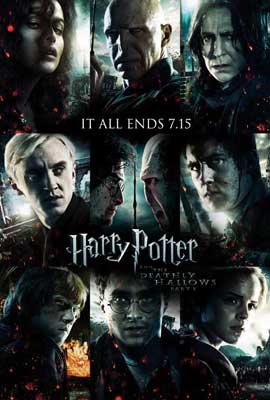
Harry Potter and the Deathly Hallows Part 2 Marketing

Harry Potter and the Deathly Hallows: Part 2 was the most marketed and advertised film out of all of the Harry Potter films, due to it being the finale.

The first main way in which the film was marketed was through the means of posters. Many posters were released months before the release of the film in cinemas, with captions such as "IT ALL ENDS: 7.15". Not only does this caption supply the information that this is the last of the films, (also using capital letters to grab the viewers attention), but a date for the release of the film is provided. The date being there adds further information about the film. Also on the posters were close up photographs of all of the main characters and famous actors that will feature in the movie. The use of a close up allowed the characters' faces to fill up the entire width of each poster, allowing the viewer to only focus on the actor/character and the caption along the bottom. Below there are examples of the posters that were released in the upcoming months of the films release date in cinemas. The fact that there are so many indicates that the many actors in it were worth seeing, for they couldn't settle with a couple of posters.


The next way in which Harry Potter and the Deathly Hallows: Part 2 was marketed and promoted was through the means of trailers. Multiple trailers advertising the film served for different purposes. The first teaser trailer was to allow the consumers to understand that there is another Harry Potter film coming out later in the year (no specific date was announced, instead the text said 'Coming Soon'), and also establish their target audience. However, later on in the year, an official, longer trailer was released showing the main highlights of the movie, along with the age restrictions and the release date. Many more trailers were released as it got closer to the release of the film, in order to remind people to go and see it in cinemas and keep the excitement and anticipation levels up for the consumers. Also, due to the fact that it is the grand finale, it may interest those who haven't even seen all of the films, so they can know how it ends. This interest is provoked, once again, through the use of captions such as "IT ALL ENDS". Below is an example of a trailer that was released, and became popular through the use of advertising on social media.


The final way in which Harry Potter and the Deathly Hallows: Part 2 became popular through the use of marketing was through premieres. Often in film premieres, the cast and writers reveal a bit more about the film but obviously not enough to spoil the experience, but most likely enough to draw in the audience more and make them want to find out what happens in the final, and the fastest way in which they can do that is by watching the film (aside from, of course, reading the book on which the film is based on).


To conclude, Harry Potter and the Deathly Hallows had many different trailers in order to release more information each time to capture the attention of the consumers/audience, and revealing more by both the narrative and clips shown to get interest from either previous fans or even new fans that are simply interested in seeing the actors in it, or any other reason. The producers create multiple posters as main part of a scheme to get a wider audience. They do this by revealing different members of the cast and possible quotations from the film in large capital letter text in order to attract the attention of a consumer. They often use the main characters on different posters in order to gain more interest, and the more in which the actor/actress is known then the more people in which will become interested in the film. These ways are the most common ways in which to market a movie, and Harry Potter and the Deathly Hallows: Part 2 was no exception to these techniques, having done all of them in order to gain as much popularity in cinemas as possible.

Tuesday, 20 January 2015

Representation of Sexuality


Sexuality has been represented in this extract through a number of ways, such as through sound, mise-en-scene and editing. In this essay, I shall write about how the sexuality of the characters in this clip have been portrayed, and why they have been portrayed in this manner.

Body language is the first way in which sexuality is represented to us in this extract. Opening with a two shot of a woman holding a dress up to another woman in quite an eager manner shows us that they are comfortable around each other, and they have somewhat of a close relationship. One woman then proceeds to move herself behind the other woman, placing her hands on her shoulders in a comforting manner. They both appear to be breathing quite heavily and rapidly, which suggests excitement at the prospect of the dress, but could also suggest excitement at being close to each other. Narration then begins in the clip, which the audience can assume comes from the woman looking at the other woman with the dress. The narrator says "She looked so beautiful". Although this cannot confirm romantic feelings, due to the fact that she may have just been admiring her beauty (perhaps jealous of it), it can be assumed from the way the woman looks up and down at the woman with the dress with a look of guilt on her face. The woman in the dress speaks, saying "Oh my goodness, miss". From this dialogue, it can be inferred that the women are not close enough to call each other by their informal titles, instead settling with "miss". The woman continues to talk, stating that she "looks like a real lady". To this, the other woman smiles, but her facial expression returns to that of neutral, or slightly guilty.

Later on in the clip, a zoom panning shot is introduced, showing one woman asleep and another awake, leaning over her. The woman that is awake begins to hover her hand over the woman's body, but not quite touching it, indicating that her feelings for her are forbidden, or must be kept secret. This indication is further reinforced by the fact that she is wearing a glove, keeping her even further away from touching the other woman. The woman's facial expressions are that of sad, or desperate as she hovers her hand over the other woman's body, allowing the audience to understand that there is not a mutual feeling of lust in the relationship between both women.

A close up of the woman painting is then shown, and she appears to be concentrating a lot. A long shot of the woman she is attracted to is shown, and she is sleeping. A man then appears, and tries to convince the woman painting that she must act in love with him. She ignores him, however, indicating that she will find it difficult to do such a thing. The music used is quite mysterious, or something that would be used for something sneaky or forbidden, reminding the audience that the woman is feeling guilty for having this emotions. The woman then tells the man to "wake her or she'll burn". This suggests that the woman cares for the safety of the other woman, reinforcing that she has feelings for her. The next shot is a close up of the sleeping woman's breasts, and a reaction shot from the painting woman. She appears to be captivated by looking at the other woman's body, her mouth opening slightly and her eyes going glassy. She then is shown to be so distracted that she doesn't notice that the man has taken notice of her staring. The woman's paint the begins to drip from the brush onto her dress, reinforcing the fact that she is distracted by the woman's body. As each drop hits her dress, the music intensifies, suggesting that her clumsiness is becoming evident to the man, and that it is quite dangerous for him to know about her romantic feelings.

The man then grabs hold of the woman and forcibly drags her away from the sleeping woman. She makes several attempts to leave before the man starts talking. He mocks her by stating that she ruined her dress with a "retched little finger smear", indicating that whilst it may have appeared to be such, he knows it is due to her distraction from looking at the other woman's body. He then proceeds to mock her saying that the other woman would "laugh in her face" if she found out about the woman's sexuality and feelings for her. The man then starts to threaten her by saying "If I told her…". The woman appears terrified at the prospect, whispering in a frightened manner "You mustn't". The fact that she whispers suggests that with the man blackmailing her, she is trying to appear weaker or less authoritative in order to please him, and make sure he doesn't reveal her sexuality. She also appears to stop looking at him in the eye, another sign of weakness. It can be inferred from this that the woman finds the thought of her sexuality being revealed as mortifying, and/or embarrassing, and she is prepared to act wearier in order to prevent that from happening.

However, when the man tells her what she must do, which is to "Appear to love him, marry him". The woman looks him in the eye and tells him that "She can't", indicating once more that she is not heterosexual, and she doesn't wish to marry a man, despite his threats. The sleeping woman wakes up and is shown to be calling out to the other woman. The woman looks up at the man, who raises his eyebrows at her, and she says "please" very quietly, which suggests that while she is not happy marry him to prevent her sexuality from being revealed, she is not unprepared to still act weaker, or in his debt. The woman that was sleeping is getting closer, however, and the other woman appears to give up and nods her head to the man, allowing him to start acting romantically towards her. Whilst this is occurring, she has a look of disgust on her face, once more reminding the audience that she is not heterosexual and does not enjoy contact with a man.

Later on, a mid-shot of the woman who had been sleeping taking off her top is shown, in slow motion. This is to show that the other woman's eyes are fixated on her every movement. The body language shown here indicates that she is trying to restrict herself from getting closer to the other woman, for she is looking up quite slowly and reluctantly. Later on, a high angle of her lying in bed with her hand on her mouth, looking very afraid is shown, to once more indicate that she is scared due to her sexuality, and she wants to keep it a secret evidently extremely desperately.

Tuesday, 13 January 2015

Representation of Ethnicity


Ethnicity is represented in this Hotel Babylon clip through a number of different ways, including through the use of camera work, sound and mise-en-scéne.

Within the first minute of the clip, costume is used to represent ethnicity. The man that climbs out the swimming pool has dreadlocks, and a beaded necklace which are stereotypical for someone of that ethnicity. The man he is talking to, although of the same ethnicity, is wearing formal attire. This shows us that he is not conforming to the stereotype, and is different from his friend now. His friend seems to notice this, and comments "Look at you all slicked up, bro". The language used here is another stereotype common with this ethnicity, using slang terms such as 'bro' and 'slicked up'. When the man in the suit comments on the physical appearance of his friend, saying he's "looking good", he is given a raised eyebrow. This representation of confusion or mockery suggests that the friend thought it odd for his body to be complimented on by a man, so he changes the subject immediately. This suggests that the males of this ethnicity feel the need to show their masculinity. This body language is an important factor when concerning how that particular ethnicity deals with such situations.

The two continue to talk, with shot reverse shots, when the man in formal attire then proceeds to inform his friend that he should "get back to the desk", showing that he is professional and, yet again, quite unlike his friend. His friend stops him, however, and asks him if he wants to have a party. When the man replies doubtfully, which is shown through his body language (looking down, putting his hand on his head), his friend appears to see this doubt and stops him by saying "We ARE having a party, bro". In that part of the clip, the friend is seen as bossy, which could lead a representation of a stereotype of that ethnicity. He then proceeds to inform him of what would occur at such a party by saying "Booze, Girls and Ganja". Having an interest in booze and girls is a very stereotypical masculine trait, which further adds to the idea that male members of this ethnicity are stereotypically masculine. 'Ganja' is a slang term used for Cannabis, which backs up the portrayal of this ethnicity using different vocabulary to stereotypical British people. The man in the suit immediately responds, trying to get out of the situation, clearly uncomfortable, saying "You don't have to...". His friend interrupts him yet again, however, and doesn't take no for an answer. When the man in the suit realises there is not an alternative to attending this party, he says "Sounds good, bro" quietly, suggesting that he isn't used to speaking in that manner anymore for he has escaped the stereotype that is held to those with his ethnicity, or a similar ethnicity to him. The friend replies "That's the old Benjamin right there, man", indicating that Benjamin was once like his friend in his mannerisms and vocabulary, but has changed quite significantly.

In the following scene, opened with a tilt shot, Eastern European maids are represented through the use of costume and accent. This alone is already portraying a stereotype, which is that Eastern European people work in low paid jobs, and are generally used as maids or cleaners. The tilt shot was used to allow the props of the cleaning materials to be seen, as well as the maids, within one swift shot. The non-diegetic music used before the Eastern European maids enter the room could be described as ominous and foreboding, allowing the audience to understand that the maids are doing something they shouldn't be. One maid says to the other that the hotel visitor will pay "double for double", referring to the maids themselves. The facial expressions of the new maid are that of impatient and irritated, showing that she is not happy to do what she is about to do and is not afraid to show it. This is further shown during the part of the scene where she leaves, stating that she's sorry and "can't" continue what she is doing. This is the second time a member of staff at this hotel has not conformed to the stereotype placed on their ethnicity, even though both of the characters came into contact with someone of the same ethnicity that had conformed. The other maid rolls her eyes as if it is a normal occurrence, and has a phone ready to call someone to replace her. This shows that she is prepared in obtaining the money, adding to the stereotype that Eastern European's are in need of money due to their low paying jobs. Also, the Eastern European women are portrayed as sex objects, there for the purpose of entertaining the Asian man in the room.

The fact that the Asian man doesn't speak a word during the clip helps us understand his ethnicity, due to him being unable to speak fluent English. The costume given to the Asian man is quite revealing, for he is only wearing a dressing gown. This supports the stereotype that Asian men are sex-obsessed, and is further supported by the close-up reaction shots of the Asian man looking excited at the prospect of seeing the Eastern European maids take off their clothing. When the diegetic track starts playing, turned on by the Asian man, it is revealed to us what the maids are expected to do, due to the type of music playing.

Towards the end of the clip, the kitchens are introduced with another tilt shot, used for the same purpose as the tilt shot earlier in the scene, to allow the props (food, ingredients, kitchen utensils, etc.) to be seen before the people. The staff are wearing chef outfits, which allows us to make a full judgement of where the scene is being set. From the moment the chef speaks, it is understood that he is Italian due to his very prominent accent. The body language of the Italian is also very stereotypical, for example, kissing his finger tips. The chef repeats the word "Welcome" many times, which is a trait used by Italians often in the media. All of these stereotypes together led to the eventual conclusion of what ethnicity this man belongs to, and is very difficult to miss by the end of the minute of the clip he is in.